The text titled “He fought for free Poland at sea – about a torpedo operator from Błyskawica”, telling the story of Adam Pieluszczak, was published by us in Gazeta Drezdenecka in September 2016 (No. 7, pp. 6-7). It was also included in our newspaper’s online edition and has been read by thousands of people, including Stanisław Feruś from Strzelin, who shared with me, in a telephone conversation, his inner feelings sparked by this article. He also told me that his uncle, Tomasz Feruś, served on board the warship Błyskawica and, after returning to Poland, faced similar problems as Adam Pieluszczak. He then sent me by e-mail some brief information about this distinguished seaman, which was, however, insufficient for writing an article. Therefore, we arranged a meeting that took place in Drezdenko on 22 April this year. On that day Tomasz’s nephew and his wife Agata first visited Stanisława Nowak and Henryk Pieluszczak in Gościm, where they scanned all the photos made available to them from an album of their father – Adam Pieluszczak, a torpedo operator from Błyskawica, and then came to meet with me. Additional, more detailed information about Tomasz Feruś, along with that previously obtained, has enabled me to write this text.
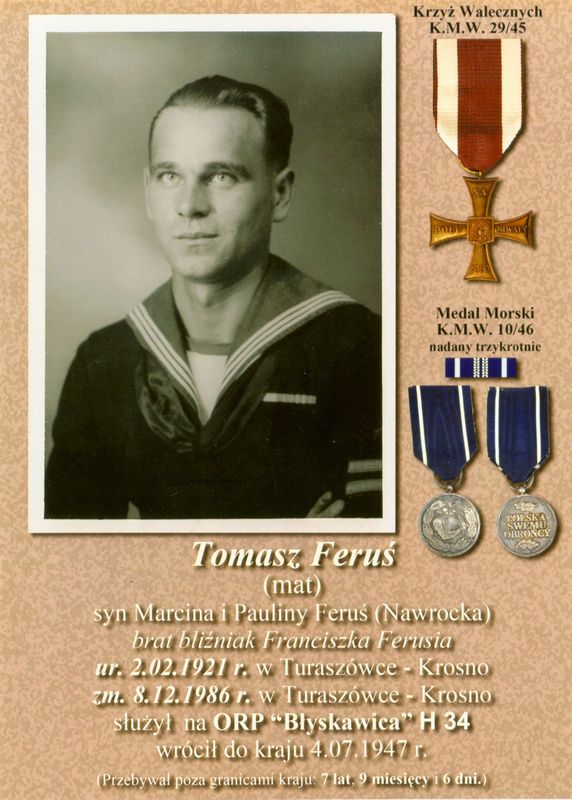
Tomasz Feruś was born on 2 February 1921 in Turaszówka near Krosno (now a district of this industrial town), located in the interwar period in the Lwów Province. Tomasz’s parents, i.e. Paulina Feruś née Nawrocka and Marcin, ran a small farm that could not fully meet the needs of a family of ten, which prompted his father to find additional work outside of agriculture, as a locksmith. His son Tomasz, after completing an elementary school in Odrzykoń[1], pursued further education at the Basic Vocational School at the aviation works. After its completion he was employed in those works as a welder.
After Poland’s defeat to Germany in September 1939, together with his twin brother Franciszek and their elder brother Józef – a priest and a La Salette missionary, he left his homeland and headed for the still free France. Raised in the spirit of love for their home country, they could not remain idle. They decided to fight for the freedom of Poland and protect themselves from enlistment into the enemy German army or, in the case of a flight towards Lwów, from enlistment into the Soviet Red Army or deportation to Siberia. At night, on bicycles, they crossed the Hungarian territory and soon arrived in Budapest (ca. 430 km), where they obtained fake passports as Jews fleeing to Palestine. With the financial assistance of Józef Feruś’s friend they got to Bucharest. After that, through Romania and Yugoslavia, they came to Italy. In the Naval Register (a note on the cover) one can read: ‘He crossed the Romanian border on 28 September 1939 and travelled through Yugoslavia and Italy’. They reached Lyon on 4 October 1939. In France their paths split. Father Józef returned to Italy and settled in the La Salette house in Turin, where he survived the whole war, carrying out his service as a priest. Father Józef had a joyous encounter with a Polish Army unit, which came to Turin through Monte Casino, Ancona and Milan. The friendships made and the pastoral care exercised facilitated his emigration to the United States. The twin brothers – Tomasz and Franciszek – went in different directions in France.
In December 1939 General Władysław Sikorski, the Minister of Military Affairs, gave his consent for the announcement of a volunteer navy draft for Poles staying in France. The draft covered young people born between 1920 and 1922. 997 volunteers presented themselves, 336 of whom, including Tomasz Feruś, were admitted to naval service. On the other hand, Franciszek Feruś joined the 2nd Rifle Division commanded by General Bronisław Prugar-Ketling. On 18 and 19 June 1940 the Division fought battles with German armoured forces for the town of Maiche and on the Clos du Doubs hills. After it ran out of ammunition, a decision was made to withdraw the troops to Switzerland. At dawn, on 20 June, around 13,000 soldiers of the Division crossed the border in several locations. Its combat losses included: 41 killed, 134 wounded and 2544 missing or captured. The Division’s soldiers remained there throughout the war. In Switzerland Franciszek Feruś completed a degree programme at a student camp in Winterthur, obtaining a master’s diploma in philosophy. Such diplomas were also received by 8 other Polish soldiers. Platoon Leader Officer Cadet Franciszek Feruś, Stanisław’s father, returned to Poland in the autumn of 1945 or at the very beginning of 1946. As a settler on the Recovered Territories he settled in Strzelin, where for many years he was the managing director of the local furniture factory. He died suddenly on 8 June 1974, at the age of 53, leaving behind his second wife[2] and nine children. Stanisław, who is now seeking to preserve the memory of his forgotten uncle, was 7 years old at the time.
After the war Father Józef Feruś first went to the United States and in 1949 was transferred to Canada. In Beausejour he worked as a vicar under the supervision of the parish priest Father Peter Jaworski. After the latter’s death in 1959 he took over the administrative responsibility for the entire parish. For his conscientious work he was awarded the Silver Cross of Merit by the Polish War Veterans Association in 1972. In the final years of his service as a priest he looked after the chapels in Cloverleaf and Stead. He was diabetic. He died of a heart attack on 6 June 1973 at the age of 62.
Let us go back to the story of our principal character, Tomasz Feruś. He spent some time at Camp Coëtquidan in France. There, while serving in the 2nd company of the school battalion, he was properly trained and took a solemn oath, after which, on 15 May 1940, he was enlisted as a crew member of Błyskawica. Błyskawica, which has been a Polish Navy museum ship since 1 May 1976, was built in 1936 at the John White shipyard in Cowes, England. She was commissioned in 1937 and her first commanding officer was Cdr Tadeusz Morgenstern-Podjazd. She was a modern destroyer, armed with eight 102 mm guns, eight 13.2 mm heavy machine guns, four torpedo tubes, four throwers and two depth charge projectors. The total length of the ship was 114 m. and her maximum width was 11.3 m. Although she was designed for a crew of 192 officers, non-commissioned officers and seamen, around 200 men actually served on her. Her second commanding officer, from 4 January 1938, was Lt Cdr Włodzimierz Kodrębski. In the face of the imminent war three Polish warships – Grom, Burza and Błyskawica[3] – set off from Gdynia on 29 August and headed for England. They first moored at Leith and later at Rosyth. When Great Britain and France declared war on Germany on 3 September 1939, the Polish ships joined the war operations at sea alongside the British navy.
Soon afterwards our destroyer took part in covering the evacuation of Allied troops from Dunkirk to England. It was a large-scale operation, with close to 400,000 Allied, mainly British, soldiers waiting in Dunkirk. 848 seagoing ships and 150 warships, including the famous Błyskawica, participated in the operation, code-named “Dynamo”. On 29 May 1940 Błyskawica towed to Dover the British destroyer Greyhound, damaged and tilted to one side, with a thousand soldiers on board. On 30 May she rescued 15 survivors from the Siroco destroyer. At that time Tomasz Feruś was on board for the first time in his life, having served on the ship for eleven days. He was only nineteen.
On 26 May 1940 Błyskawica patrolled the English Channel, together with the British destroyer Galatea. When she was anchored in a harbour along with the British destroyer Vega, on the night of 27 and 28 May, they were attacked by a German aircraft, but the gunners, including Tomasz Feruś, managed to withstand the attack.
On 4 December 1940 a storm with a force of 10 to 11 degrees on the Beaufort scale caused serious damage on board. The rudder failure was removed thanks to the dedication of Lieutenants Franciszek Czelusta and Zbigniew Węglarz[4] and twelve seamen accompanying them. The ship inclinations reached 62 degrees. The crew was at the end of their physical and mental powers. After thirty hours of storm the ship finally took a course on Greenock. The elimination of damage lasted until 10 February 1941.
From 30 August to 11 October 1941 Tomasz Feruś served on board the Polish warship Krakowiak[5], which was commissioned in the first half of 1941. Krakowiak operated in the British coastal waters until July 1943. The ship was equipped with strong anti-aircraft and anti-submarine weaponry. It had six 102 mm, four 40 mm and two 20 mm guns as well as depth charge launchers and projectors.
At the end of 1941, after being renovated and refitted, being better prepared to combat submarines, Błyskawica sailed from Cowes to Scapa Flow, where the crew received additional training, and from there was directed to Greenock, where she joined the escort group of destroyers. Tomasz Feruś was again aboard Błyskawica, from 6 November 1941, and remained there, apart from leave and training periods, until the end of the war.
Błyskawica often escorted large troopships, such as the Queen Elizabeth ocean liner in mid-February 1942, carrying several thousand soldiers. In mid-March 1942, while escorting a large troopship from Greenock to Reykjavik, it fought a battle with German long-range aircraft, and in the firs